The Plasy Branch
Translated from the Czech by Claude, an AI model by Anthropic, in 2026.
Founder: Antonín Prusík, 1799 – 1867
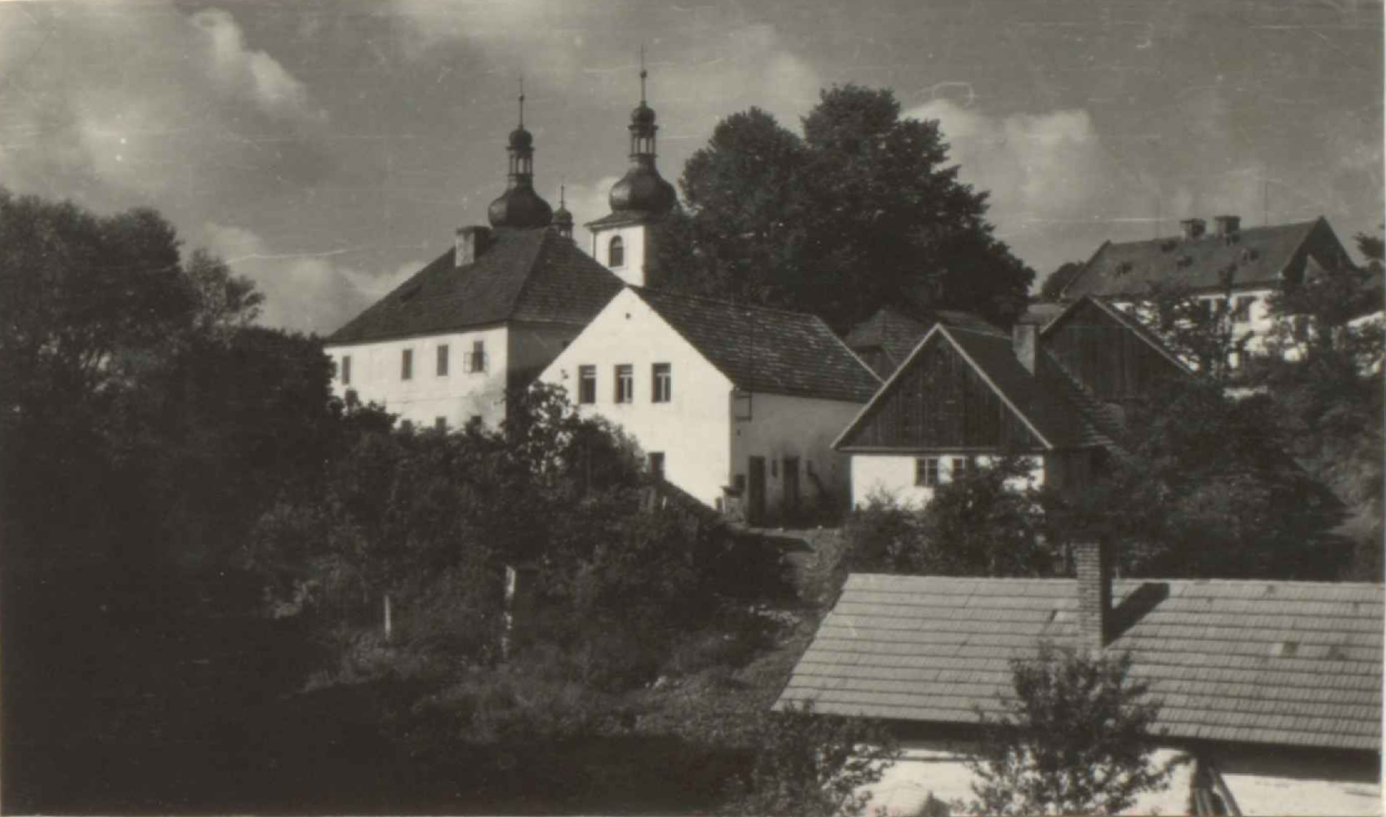
The first Prusík came from Sedlec to historic Plasy around 1700. Since in our family's native region Plasy was, besides Kralovice, the only larger place, some member of the family has lived in Plasy ever since those days, right up to the present. In the second half of the 18th century another Prusík came there from Sedlec, namely Martin. He was already related to those who had lived there before him. We have written that Martin Prusík, born in 1745 in Sedlec and later settled in Plasy, had three sons besides daughters. We have already told of his son František, the founder of the Červená Řečice branch, and of Josef, the founder of the Nebřežiny branch, and of their descendants. Martin's youngest son was Antonín. He was born when his father was 54, in Plasy, on 21 January 1799. It was the time when in France Napoleon Bonaparte is slowly taking power, and Europe was then very unsettled. The Napoleonic Wars were slowly drawing near.
Antonín Prusík learned the mason's trade from his father, but at a relatively young age he had to put on a soldier's uniform, and it was quite a long time before he came home again. His wife was the daughter of Dürschmied, the first Czech teacher in Plasy. This was Josefa, born in 1801. They had several children, but only two grew up and had descendants. These were Antonín Prusík and Josefa, whose married name was later Lašková. Antonín Prusík the mason died in Plasy on 19 August 1867. His wife died soon after the birth of their little daughter Františka, on 30 January 1833. The child died too.
The first child of Antonín Prusík, the mason of Plasy, was his son Antonín. He was born on 13 February 1828. He trained as a joiner. Since there were no conditions in Plasy at that time for setting up a new business, Antonín Prusík settled nearer Plzeň, in Třemošná. There he gained customers from nearby Plzeň too, and he began to do well. His wife was Marie Havlíková, born in 1830 in Nebřežiny. For a short time Antonín Prusík was also in Kaznějov, and when he grew old he settled in Plzeň, and there too he died, on 5 May 1895. His wife preceded him to the grave and went to her eternal rest on 3 October 1894. Both were buried in the little churchyard of All Saints in Plzeň.
Antonín Prusík and his wife Marie had three sons and three daughters. Unfortunately the fates of some of them will now probably remain veiled in mystery for ever.
The eldest child of Antonín Prusík, the joiner, was his son Antonín. He was born on 7 June 1859, trained as a tailor and remained unmarried. He died at only thirty, in 1889.
The second son was Karel Prusík. He was born on 24 January 1861 in Třemošná. He learned joinery from his father, and when he got to know Marie Moudříková, who was born in Velvary on 16 September 1856, he married her and settled in her birthplace
and set up his own business there. Karel Prusík was a very strong and good-hearted man; in his young years, in the army, he was a lifeguard, and when he lived in Prague he was a firefighter. He also took part in fighting the fire at the National Theatre in August 1881. In later years, when this event was commemorated and those who had saved our Golden Chapel above the Vltava, as the National Theatre is called, were rewarded, recognition and a medal came to Karel Prusík of Velvary too. To the end he kept this keepsake of his with reverence. When Karel Prusík's wife Marie died on 26 May 1916, he married again, namely Antonie Kristlová, born on 7 June 1879 in Rychnov nad Kněžnou. Towards the end of his life his trade began to tire him, and then, remembering his young years by the water, he bought a piece of meadow at Litol near Lysá nad Labem and set up a swimming bath there. Karel Prusík did not, however, live there long; he died on 10 September 1938 in Litol, and his second wife already on 16 February 1936. With her he had no children.
Karel Prusík had one son and three daughters. His youngest daughter, Antonie, born on 14 November 1898 in Velvary, died unmarried on 4 June 1916. At home they called her Marie. The other children left descendants.
The eldest child of Karel Prusík in Velvary was his daughter Růžena. She was born on 14 February 1888. In 1908 she married the barber Adolf Beneš, who had his business in Pozdeň near Slaný. Then the couple moved to Plchov, where they stayed until 1946, and from there they moved away to Litvínov. The widow Růžena Benešová lives in Litvínov, Wolkerova 7. The Benešes had 13 children, and seven of them grew up. The eldest son was given his father's name, Adolf. He was born on 24 December 1909 and trained as a mason. For a short time he was also with the railway and in the collective farm (JZD). Then he went back to the building trade, where he still works. He is childless. He lives in Prague 6, Břevnov, Pod Královkou 1943.
The second child of Růžena Benešová is her son Karel. He was born on 4 April 1914; he works for the railway and lives in Radčice near Duchcov. He has four children. His daughter Hana, born on 11 June 1941, has the married name Altmanová. She has a little daughter, Marcela, born on 1 May 1964. His second daughter is Eva, born on 21 July 1945, whose married name today is Havelková. She has a little daughter, Eva, born on 21 August 1965, and Zuzana, born on 21 December 1966. Karel Beneš also has two sons, Karel, born on 22 January 1955, and Josef, born on 19 March 1947.
The eldest daughter of Růžena Benešová, née Prusíková, is her daughter Růžena. She was born on 3 March 1921, and her husband is a baker, Čech. She lives in Karlovy Vary, třída čsl. armády 18. She has three daughters. The eldest, Stanislava, born on 9 May 1946, has the married name Píšová. She has a little son, Kamil, born on 4 February 1966. The second, Miroslava Čechová, was born on 19 April 1948. The next daughter, Marie, was born on 12 December 1952.
Her son Květoslav Beneš, born on 15 September 1923, works at the Zbrojovka arms works in Týnec nad Sázavou and lives at Racek No. 24, near Benešov. He has two daughters, Jaroslava, born on 6 November 1949, and Dana, born on 26 March 1951. Another daughter of Růžena Benešová, née Prusíková, is Kristýna. She was born on 16 November 1925, and her husband is Luňák, an engineer at the Chemical Works in Záluží. She lives in Litvínov, Wolkerova 7. Hana Altmanová also has a little son, Zdeněk, born on 25 February 1968.
The Luňáks have seven children. They are: Stanislav, born on 20 December 1946, Jitka, born on 6 March 1948, Miloslava, born on 16 September 1950, Jana, born on 13 January 1952, Evžen, born on 8 November 1954, Miroslav, born on 18 July 1956, and Michaela Luňáková, born on 1 February 1967. Another son of Růžena Benešová is Zdeněk. He was born on 22 August 1929. He worked in a spinning mill, was an agronomist on a state farm, and today he is in the mines. He lives in Lom near Most, Gottwaldova 121. He has two children, Vlasta, born on 7 October 1951, and Zdeněk Beneš, born on 18 October 1953.
The last child of Růžena Benešová is Evžen. He was born on 2 March 1931 and lives in Litvínov, Smetanova 8. He works for the drilling company Ingstav. He has a little daughter, Anna, born on 20 April 1956. The family of Růžena Benešová, née Prusíková, is thus truly numerous, and if her descendants reach such an age as she has and stay as lively all the while, they may congratulate themselves.
Karel Prusík, the joiner of Velvary, had a son, Oldřich. He was born on 23 February 1893 and trained as a bookbinder. In 1920 he married Jana Zikmundová, who was five years older than he; she was born on 16 May 1888 in Bakov nad Jizerou. Oldřich Prusík then settled there. The marriage, however, broke up in 1930, and Oldřich moved to his sister Růžena in Prague. In the end he lived in Most, but he was beset by numerous ailments, of the gall bladder and the heart, and asthma, and all this drove him to suicide; he hanged himself on 5 September 1959. He is buried in Most. Oldřich Prusík had two children. His son Jiří was born on 27 July 1921. He studied at the Commercial Academy in Mladá Boleslav, then worked for the North Bohemian Paper Mills in Bělá, Česká Kamenice and Teplice, at Stavostroj in Bělá pod Bezdězem, and then at the State Savings Bank in Doksy. He is now a clerk at the Paper Mills in Štětí nad Labem, where he lives at U stadionu 479. His wife is Blahomila Čirková, born on 15 January 1930 in Bítouchov near Bakov. They have a daughter, Blahomila, born on 23 May 1953. For quite a long time Jiří Prusík knew almost nothing of the family to which his name says he belongs. Today, on the contrary, he takes an unusual interest in the whole family, its origins and its members.
The second child of Oldřich Prusík was his daughter Blanka. She was born on 11 September 1925. She married Vladimír Nový, a clerk at the sugar refinery. She is a teacher in Dolní Slivno near Mladá Boleslav, where she lives at No. 76. Blanka Nová, née Prusíková, has two sons, Vladimír, born on 21 October 1954, and Aleš, born on 21 March 1957.
The third [sic, properly the second] daughter of Karel Prusík, the native of Třemošná who settled in Velvary, was Božena. She was born on 11 January 1897 and married the merchant Ladislav Krejsa. When private businesses and shops were being abolished, they moved to Horní Počernice, Heydukova 1215, where they bought a little house. Růžena [sic, probably Božena, as above] Krejsová, née Prusíková, died early; the cause was cancer. She went to her eternal rest on 5 March 1955. She had three sons. Oldřich, born on 12 February 1925, became a clerk, but being sent to work in production proved fatal to him and was the cause of his premature death on 30 October 1959. He left a little son, Vladimír, born on 9 March 1953.
Vladimír Krejsa, the orphan Oldřich left, lives in Prague-Hostivař, Strašnická 6.
The second son of Růžena Krejsová, née Prusíková, is Ladislav. He was born on 8 June 1927; he was a druggist and now works as a regional inspector in this field. He lives in Říčany, Smiřických 321. He has two children, a son, Jan, born on 23 June 1952, and Ludmila, born on 6 June 1955.
The third son of Růžena Krejsová is Zdeněk, born on 1 March 1934. He trained as a bookbinder and is unmarried. He lives with his widowed father in Horní Počernice.
We shall now mention the four children of Antonín Prusík, the joiner of Třemošná, whose later fortunes have remained unexplained to us. They were three daughters and one son, and all of them once went away to Bosnia. Certainly no person bearing the name Prusík is living in the whole of Yugoslavia today. If there were, they could only be descendants of Josef Prusík, who was born on 18 July 1866 in Třemošná and in 1877 [sic; the remarks at the end of this chapter place their departure after the occupation of Bosnia, which was in 1878, so either this year or that account is wrong] left with his sisters for Vareš near Sarajevo. His three sisters were Marie Prusíková, born on 11 February 1862, and Magdalena, born on 29 July 1864, both in Třemošná, and the last, Anna, born on 20 August 1870 in Kaznějov. All that is known today is that one of them married a gendarmerie sergeant and another a head forester. Of the third, Anna, who followed her sisters later, it is not known whether she married too. Quite simply, there are no traces left today that one could take hold of. The names of their husbands are not known, nor the places where they settled. These are the only gaps in the history of this family, apart from Josefa Křížová, née Prusíková, of Nebřežiny, whom we have already mentioned.
The second child of Antonín Prusík, the mason of Plasy, was his daughter Josefa. She was born there on 3 September 1830. She married Lašek, a teacher in Plasy. The teacher Lašek, and his father before him, were tutors in the family of Prince Metternich at Plasy. Three sons were born to Josefa Lašková, née Prusíková, in Plasy. One of them was Jan, born on 9 May 1860, who later became very famous as the actor “Hanuš” Lašek. At first he was a teacher, and on the recommendation of the conductor Čech, which his relative Josef Prusík in Prague arranged, Hanuš Lašek was invited in January 1885 by the director of the National Theatre to an audition. Hanuš Lašek first appeared as a guest at the National Theatre on 18 November 1886, in the part of Max in the opera Der Freischütz. In September 1887 he was engaged as a lyric tenor at the German municipal theatre in Opava. From there he went to the Court Opera in Vienna. His name is then interestingly linked with the memorable participation of the National Theatre in the theatre exhibition in Vienna in 1892. This marked the first decisive triumph of Smetana's The Bartered Bride on foreign soil. After the first successful performance the tenor Karel Veselý, who sang the part of Jeník, suddenly fell ill. At the critical moment, when the next performance was in serious danger, Hanuš Lašek, who happened to be in Vienna, stepped in with great success. In this way he not only saved the performance but, by his singing and his acting, then won himself membership of the opera company of the National Theatre.
For financial reasons, however, as was often the way with artists, he left after only five years, as a heroic tenor, for the Royal Court Opera in Dresden. Hanuš Lašek then also worked in Gdańsk, Bremen and Aberdeen in Scotland, where he remained until 1908. In 1908 he settled permanently in Prague, where he founded his own school of operatic singing. His first and second parts number 110 in all. Among Lašek's most popular roles may be counted, in particular, Manrico in Il trovatore, Jeník in The Bartered Bride, Lohengrin, Barinkay in The Gypsy Baron, and others. Hanuš Lašek was also active as a writer. He wrote a treatise, “Kriteria starovlašských pěveckých škol v XVII. a XVIII. století” (“Criteria of the Old Italian Schools of Singing in the 17th and 18th Centuries”).
Had Hanuš Lašek worked longer at our National Theatre, he would probably be remembered today with still greater glory. Beyond dispute, however, he belonged among the famous members of the Old Guard of the National Theatre. H. Lašek died in Prague on 21 August 1937. Hanuš Lašek married late in life. Before that, with his constant travelling and his work abroad, he had had no time for it. Two daughters were born of his marriage.
The first was Jana. She was born on 6 March 1911. She married the engineer Riegel, a textile specialist and the owner of a fine business in Lomnice nad Popelkou. Jana Riegelová now lives as a widow, a teacher, in Prague-Střešovice, Lomená 40. She has a son, Karel Riegel, born on 23 January 1942.
The second daughter of Hanuš Lašek was Hana. She was born on 24 January 1914 and early began to show a gift for music and acting. She was won over to this field by film people. She did not, however, want to profit from the fame of her father's name, and so Werich renamed her Vítová, after the poet Vítězslav Nezval, and this stage name stayed with her. She became very famous in Czech film. Her “Noční motýl” (“Night Butterfly”) in particular is still unforgettable. Hana Vítová married first the singer Jára Pospíšil and, after May 1945, which, however, brought her little joy, the lawyer Dr Rádl. With him she had a daughter, Bedřiška Rádlová, born on 8 December 1946. She was a student, but she ended her life early and unhappily. She took her own life on 13 May 1966. Hana Vítová, who knows well that through her father she belongs to our old Prusík family, lives in Prague, Gottwaldovo nábřeží 16. In our family there are not many who have devoted themselves to art. They are the singer Jindra Karezová in České Budějovice, the film actor Karel Lamač, Dr Karel Prusík, a professor at the Vienna conservatory, the opera singer Hanuš Lašek and his daughter Hana Vítová. Those are the best known.
Josefa Lašková, née Prusíková, also had a son, Václav. He was born on 25 February 1867 in Plasy. He became an officer in the Austrian army. He remained unmarried. During a military ride on horseback he fell from his horse and was killed. This happened on 21 August 1893 at Hradisko near Olomouc. Her other son, too, took up the soldier's trade. This was Jaroslav Lašek. He was born in Plasy on 15 August 1874. He became a lieutenant colonel; he was married, it is true, but he remained childless. His wife was a German woman. He died in Germany, forgotten, on 25 October 1941, at a place called Scheibe in the Kłodzko region, not far from our border. Josefa Lašková, née Prusíková, died in Příbram on 3 September 1906; she had moved there from Plasy to make her sons' studies easier.
Remarks on the Plasy Branch
You have just read about those people of our blood who belong to the family branch called “Plasy” after its founder, Antonín Prusík. There is not nearly as much of it as with the Výrov, Sedlec or Nebřežiny branches. This is partly because Antonín Prusík had only two children who grew up, and then chiefly for the reason that the fates of four of his grandchildren have remained veiled in mystery. After the occupation of Bosnia, in the 1880s, the Austrian government urged its subjects, and so those in Bohemia too, to move there. This concerned state employees in particular, but craftsmen, technicians and tradesmen too. Vienna wanted to have its own reliable people there. That call was heeded at the time, and it was then too that one son and three daughters of Antonín Prusík, the joiner in Třemošná, left their homeland. He was the son of the master mason Antonín Prusík of Plasy. What became of them afterwards (that the daughters were married is known) we shall probably never learn now. Their descendants, however, though not bearing the name Prusík, are probably living somewhere there in Yugoslavia. It is precisely they who are missing from the list of the members of the family belonging to the Plasy branch.
After the withered Červená Řečice branch and the completely Germanised “Jihlava” branch, the Plasy branch is the weakest. Only one person in it still bears the name Prusík, namely Jiří Prusík, who lives in Štětí nad Labem, and he has only one daughter. So in this branch our family will die out in the male line, though of course many will remain in the female line, people in whose veins runs Prusík blood, even though they no longer bear the original family name. Although the branch is very small, two people have made it well known to the Czech public. They were the famous opera singer Hanuš Lašek, whose name is linked in particular with the first performance of Smetana's The Bartered Bride on foreign soil, in Vienna, and then his daughter Hana, under the pseudonym Vítová, who through her film performances and her appearances on television, on the radio and elsewhere is well enough known to our people.
In the little town of Plasy, which lies north of Plzeň, you will again find people with the name Prusík or Prusíková, and many others belonging by blood to our ancient family, but no one any longer from the branch just described. Antonín Prusík has left 63 descendants up to the present day, and of these 18 are no longer living. There were surely many more of them, however, and there still are. They are probably living in the Slavonic south, somewhere in Yugoslavia. There are 12 other names. Perhaps one day in the future, after years, they will themselves claim kinship with our family, or some chance will help to discover them.
On the next page you will find, as for every branch, a list of those members of the family who were born with the name Prusík or Prusíková, with a reference to the page where you can read more about them, and the other names that occur among the other members of the family, or, as the saying goes, “on the distaff side”.